

The Smart Money Concept is a trading method based on institutional logic. It focuses on price action, liquidity, and market structure instead of indicators. SMC helps traders identify where smart money might be entering or exiting the market. The main goal is to trade with them, not against them.
Instead of chasing every candle, SMC traders wait for confirmation. They read SMC charts like professionals and understand why the market moves a certain way.
Why Smart Money Moves the Market
Smart money doesn’t enter a trade randomly. They plan their moves carefully. Since they trade with large capital, they need liquidity, which means they need buyers and sellers to fill their orders.
To get that liquidity, they often:
- Create false breakouts to trap retail traders.
- Trigger stop losses to collect liquidity.
- Push the market in the opposite direction before moving it where they want.
These tactics confuse beginners, but they make perfect sense once you study SMC.

Key Elements of Smart Money Concepts
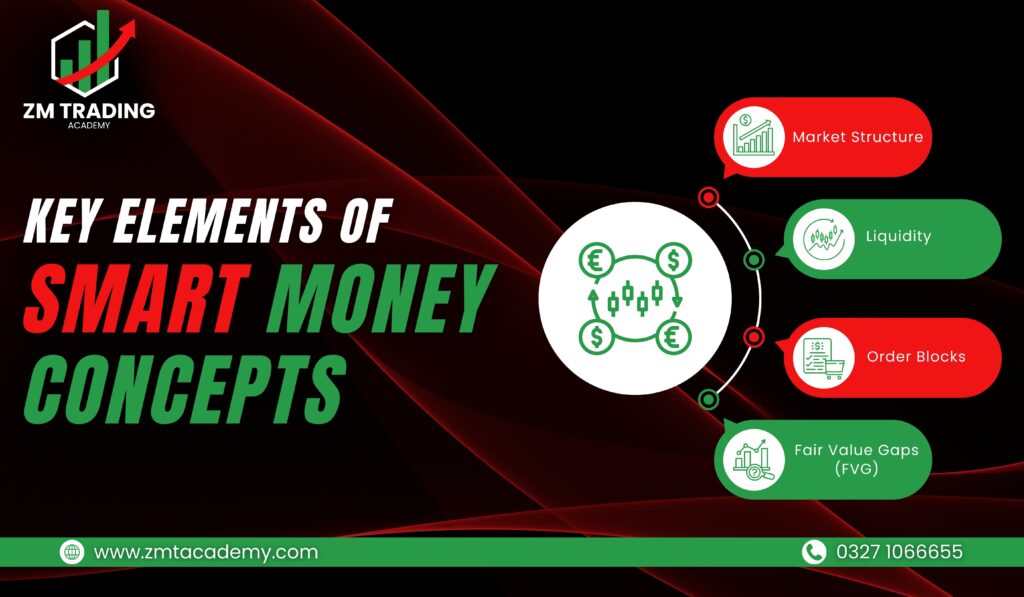
To trade SMC effectively, you need to understand these main elements:
1. Market Structure
Market structure is the backbone of price movement.
- Uptrend: Higher highs (HH) and higher lows (HL).
- Downtrend: Lower highs (LH) and lower lows (LL).
- Range: Price moves sideways.
In SMC, two key terms define structure shifts:
- Break of Structure (BOS): When price breaks a previous high or low, showing direction.
- Change of Character (ChoCH): When the market changes from bullish to bearish or vice versa.
When you understand structure, you can predict where price might go next.
2. Liquidity
Liquidity is one of the most important parts of SMC. It represents areas where stop losses, pending orders, and trapped trades exist. Institutions look for these zones because they provide the liquidity needed to enter or exit positions.
Common liquidity areas:
- Equal highs and equal lows
- Swing highs and lows
- Trendline touches
- Support and resistance zones
When you see prices hit a level and suddenly reverse, that’s usually a liquidity grab, a sign that smart money just entered or exited.
3. Order Blocks (OB)
An Order Block is a zone where institutions placed large orders before a major market move.
For example: If the price was falling and then suddenly shot upward, the last bearish candle before that rise is a bullish order block. Order blocks are used by traders as high-probability entry zones. When price comes back to that area, it often reacts strongly.
4. Imbalances and Fair Value Gaps (FVG)
When price moves too fast, it leaves an imbalance in an area where there are more buyers than sellers or vice versa. This creates a Fair Value Gap (FVG), a gap between candles where price didn’t trade evenly. Smart money often brings price back to fill these gaps before continuing in the main direction. These areas can act as entry or target zones.
5. Market Sessions and Timing
Smart money doesn’t move the market all day. They trade during high-volume times such as:
- London Session: The most volatile and active.
- New York Session: Often continues or reverses the London move.
- Asian Session: Builds liquidity and sets up traps.
Trading during these sessions allows you to catch institutional movements instead of random price noise.
Step 1: Locate Liquidity Zones
Mark obvious highs and lows where stop losses are likely placed. These areas act as liquidity pools that institutions target. For example, if you see multiple equal highs, it’s a liquidity zone above. When price breaks that level sharply and then reverses, it’s likely a liquidity grab.Step 2: Watch for Break of Structure (BOS)
When price breaks an important high or low, it signals that smart money might be changing direction. Use this as your first clue to look for a new setup. If BOS aligns with a liquidity grab, it’s an even stronger sign.Step 3: Mark Order Blocks or Fair Value Gaps
After a BOS, find the order block (the last opposite candle before the move) or fair value gap near it. These zones are your potential entry areas. Wait for the price to return there before taking a position. Patience is key.Step 4: Enter the Trade with Confirmation
Once price revisits your order block or fills the gap, look for confirmation:- Small BOS on lower timeframe
- Rejection candles
- Liquidity grab followed by reversal
Step 5: Manage Your Risk and Take Profit
The SMC stock market doesn’t risk big; they focus on consistent profits. You should too.Example of an SMC Trade Setup
Let’s imagine you’re watching EUR/USD.- On the 4-hour SMC chart, you notice an uptrend but a recent liquidity grab above equal highs.
- Price breaks structure to the downside indicating potential reversal.
- You mark the last bullish candle before the drop as your bearish order block.
- Price pulls back into that zone during the London session.
- You enter a sell trade with stop loss just above the zone.

Common Mistakes in SMC Trading
Many beginners fail at SMC because they overcomplicate it. Avoid these errors:- Using too many timeframes at once
- Forcing setups that don’t match structure
- Ignoring liquidity zones
- Trading without confirmations
- Overtrading every small move